


















Your Most Valuable Leadership Asset Isn’t on Your Resume
Not your network. Not your experience. Not your strategic instincts, though all of those matter. The resource that determines whether any of them get deployed well is your attention. And it’s probably the one thing you’ve never been formally trained to manage.
Amishi Jha has spent her career on that problem.
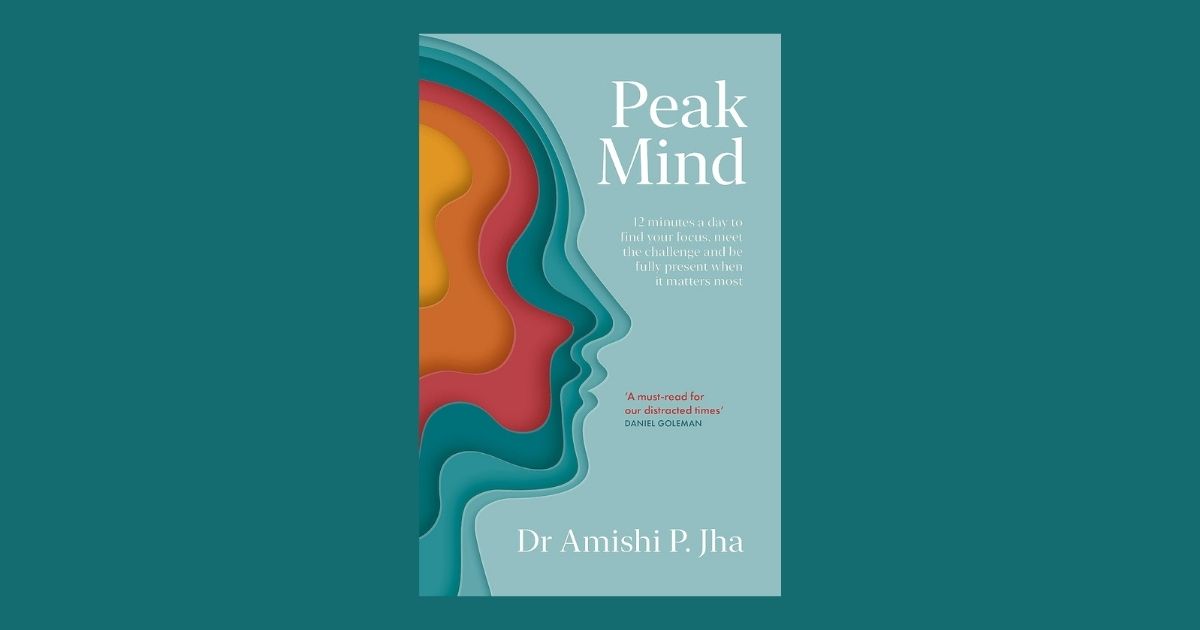
Peak Mind: Find Your Focus, Own Your Attention, Invest 12 Minutes a Day is a neuroscientist’s guide to how attention actually works: why it wanders, what depletes it, and what the research says about strengthening it. It came out in 2021, and the case for reading it has only gotten stronger since.
Who Is Amishi Jha?
Jha is a professor of psychology and Director of Contemplative Neuroscience at the University of Miami. She has studied attention at every level, from brain imaging in a lab to field research with soldiers, first responders, athletes, and executives. Her work has been funded by the U.S. Department of Defense and has produced training programs now used by the military, elite sports teams, and organizations worldwide.
She is not a wellness guru. She is a scientist who followed the data toward mindfulness and then spent decades stress-testing it under the most demanding conditions available. Her 2026 Massachusetts Conference for Women breakout session, Peak Mind: Reclaiming Your Attention in an Always-On World, brings that research directly to the CFW stage.
What the Book Argues
Jha opens with a finding that stops most readers cold. Research suggests our minds are wandering, not fully present to what’s in front of us, roughly half the time. Half of our meetings, conversations, and decisions are being processed by a mind that is somewhere else.
She is clear that this isn’t a character flaw. The brain evolved to be distractible for good reasons, and that tendency is now being actively exploited by every app and notification system ever built. The question is whether we can learn to override the default when it matters.
Her answer is yes, and the required investment is smaller than you’d expect. The book introduces a set of 12-minute daily exercises, tested across populations from medical students to combat-deployed soldiers, that strengthen three systems: what she calls the flashlight (focused attention), the floodlight (broad awareness), and the juggler (working memory). Together these determine how well you can direct attention, hold it, and shift it deliberately.
A note on what you’re getting into: the book is slightly longer than it needs to be, and a substantial portion is devoted to case studies from military and first-responder contexts. If those examples don’t grab you, the practical core is concentrated in the exercises and the chapters framing them. It’s worth skimming toward those.
For leaders, the applications extend past personal performance. Jha shows how attention shapes decision quality, emotional regulation, and whether the people around you feel genuinely led or merely managed.
What You’ll Take Away
- Attention is trainable, not fixed. This is the book’s central claim and the reason it’s worth your time. Presence isn’t a personality trait some people happen to have. It’s a capacity that responds to practice.
- Mind-wandering has measurable costs. Jha gives you a precise account of what happens neurologically when attention drifts, and what it costs in working memory and decision quality. Seeing the mechanism makes the fix feel worth pursuing.
- Stress degrades attention in predictable ways. High-pressure conditions, exactly the ones most leaders operate in, systematically erode the attention systems you most need. Understanding that changes how you approach demanding periods for yourself and your team.
- Twelve minutes is the actual threshold. Not aspirational. These are the same protocols tested on sleep-deprived residents and deployed soldiers. If they hold there, they’ll hold for a Tuesday.
- Attention is a leadership signal. How well you can direct your own focus shapes what your team experiences of you. That’s not a soft observation. It’s the mechanism behind why some leaders make people feel heard and others don’t.
Why We’re Recommending It
Leadership development usually concerns itself with what you know and what you do. Peak Mind argues that how well you can direct your own attention is the foundation the rest sits on.
Five years on, it remains the most rigorous and most usable guide to that foundation we’ve found.
Related from the CFW Bookshelf: For the physical side of screen saturation, pair this with Body Electric by Manoush Zomorodi. For the neurological roots of scattered focus and disrupted sleep, try The Busy Brain Cure by Dr. Romie Mushtaq.
Get the Book
Peak Mind: Find Your Focus, Own Your Attention, Invest 12 Minutes a Day is available wherever books are sold, including BookPeople, Amazon, and Bookshop.org.
Learn more about Amishi Jha at amishi.com.