
















Your Job Is Quietly Working Against Your Body
It’s the end of the workday: your shoulders are rounded, your eyes strained, lower back complaining, brain somehow both exhausted and wired. You’ve been productive, technically. You also haven’t moved in four hours, and your body is making sure you know about it.
For most professional women, this is just Tuesday. According to Manoush Zomorodi, it doesn’t have to be.
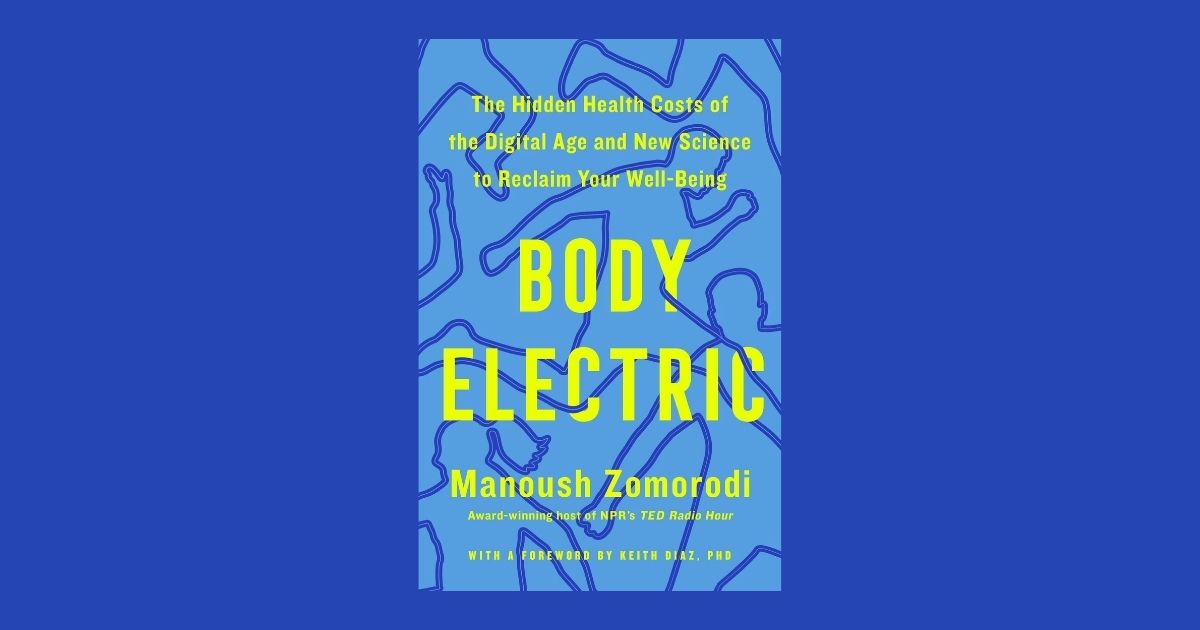
Body Electric: The Hidden Health Costs of the Digital Age and New Science to Reclaim Your Well-Being grew out of one of the largest citizen science experiments ever run on this question, and it arrives with an unusually practical answer.
Who Is Manoush Zomorodi?
Zomorodi hosts NPR’s TED Radio Hour and has spent over a decade reporting on what technology does to us. Her 2017 book Bored and Brilliant and its accompanying TED Talk, now past six million views, made her a leading voice on the attention economy. Her 2026 Massachusetts Conference for Women breakout session, Wired and Tired: The Hidden Health Costs of Our Digital Lives, takes on these findings directly, including what screen-saturated living does to women navigating hormonal shifts and menopause.
The book itself comes out of a collaboration between NPR and Columbia University Medical Center: a study of more than 20,000 participants, one of the largest of its kind. Zomorodi didn’t just report on the research. She helped design and run it, and tested the protocol on herself. The foreword is by Keith Diaz, PhD, the Columbia exercise scientist whose lab studies sedentary behavior.
What the Book Argues
Zomorodi’s starting question is one most of us quietly avoid: what is the actual physical cost of the way we work now? Not the mental health cost, which is a conversation well underway. The bodily one.
Her reporting traces a connected set of consequences that most knowledge workers experience without linking to a cause: posture problems, deteriorating eyesight, disrupted breathing, weight gain, restless sleep. Over longer horizons, the research points toward elevated risk for diabetes, high cholesterol, and heart disease.
The book’s most useful contribution is precision about mechanism. The problem isn’t sitting. It’s uninterrupted sitting. Sustained stillness disrupts specific physiological processes, and those processes reset with surprisingly little intervention. That distinction makes the solution feel achievable rather than punishing.
The resulting protocol is deliberately modest: about five minutes of movement for every thirty minutes of sitting. Not a workout. A walk down the hall, a lap around the apartment, anything upright. The study data showed measurable improvement in mood, energy, and fatigue.
One fair caveat: if you follow the Body Electric podcast, some core findings will be familiar. The book’s added value is the depth of reporting around them, and the myths it dismantles along the way. Among them, the standing desk, which turns out to be a far less complete solution than its marketing suggested.
What You’ll Take Away
- The problem is uninterrupted sitting, not sitting. This reframe is the book’s foundation and the reason its protocol is workable. You don’t need to overhaul your job. You need to break up the stillness.
- Five minutes every thirty is the target. Even five minutes every hour or two produces some benefit, which matters on days when the calendar wins.
- The symptoms are connected. Most readers will recognize two or three things they’ve experienced — eye strain, tight hips, shallow breathing, and find them traced to a common cause.
- This intersects with midlife health. For women in perimenopause and menopause, a sedentary screen-heavy routine can compound symptoms that already demand attention.
- You don’t have to opt out of modern life. The book is refreshingly free of digital detox moralizing. The technology is staying, so the question is how to work with it rather than against your body.
Why We’re Recommending It
Most career advice concerns itself with what you produce. Body Electric makes a well-evidenced case that how you physically inhabit your workday shapes what you’re capable of producing at all.
It’s short, it moves quickly, and the protocol at its center can be started this afternoon. If you read one thing this month that changes a daily habit, this is a strong candidate.
Related from the CFW Bookshelf: For more on the midlife health thread, pair this with Generation M by Dr. Jessica Shepherd. For the attention side of screen saturation, try Peak Mind by Amishi Jha.
Get the Book
Body Electric is available wherever books are sold, including BookPeople, Amazon, and Bookshop.org.
Learn more about Manoush Zomorodi at manoushz.com.