


















Your Team Isn’t Overwhelmed by the Work. It’s Overwhelmed by the Thinking.
Here’s a question worth bringing to your next one-on-one: when did you last feel truly focused at work? Not just busy — actually in deep, uninterrupted concentration on something that mattered?
For most leaders and their teams, that feeling is increasingly rare. And for years, the conventional diagnosis has been workload: too much to do, too few hours to do it. Liane Davey thinks we’ve been measuring the wrong thing entirely.
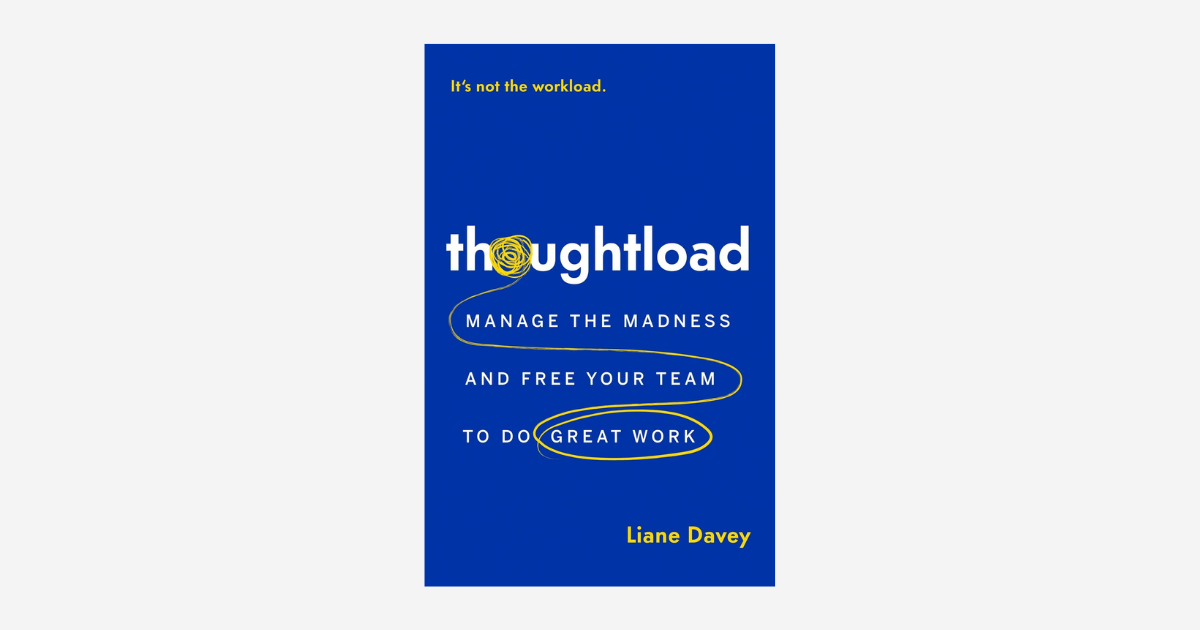
Thoughtload: Manage the Madness and Free Your Team to Do Great Work is the New York Times bestselling organizational psychologist’s most urgent book yet — a research-backed, bracingly practical argument that what’s actually breaking our teams isn’t the volume of work on their plates. It’s the invisible cognitive and emotional burden they’re carrying before they even open their laptops.
That burden has a name now. And once you see it, you can start doing something about it.
Who Is Liane Davey?
Davey has spent more than 25 years studying what makes teams work — and what quietly destroys them. She holds a PhD in organizational psychology, has coached teams from the frontlines to the boardroom at organizations including Amazon, Google, Walmart, UNICEF, and MD Anderson, and is known in leadership circles as “the teamwork doctor.” She is also a New York Times bestselling author, with previous books including You First and The Good Fight — the latter a widely acclaimed guide to productive conflict on teams.
She is, in short, one of the most credible voices in the world on why teams underperform — and what leaders can actually do about it.
So, What’s It Actually About?
Davey defines thoughtload as the cumulative burden of rising cognitive demands, growing emotional pressures, and shrinking energy reserves — the invisible tax that accumulates on every member of your team before the first task of the day begins. People are being interrupted every 11 minutes by colleagues, every 5 minutes by email, and every 2 minutes by notifications. By the time most people sit down to do their best work, their capacity for deep thinking has already been significantly eroded.
The result isn’t just burnout — it’s a specific kind of leadership failure. When thoughtload is too high, teams default to old habits and familiar scripts rather than generating fresh insight. Decisions get made on autopilot. Accountability feels like punishment. And the creative, adaptive thinking that organizations most need right now goes missing precisely when they need it most.
Davey structures her solution in three parts: attention, emotions, and energy. She gives leaders concrete tools for each — how to create the conditions for focused thinking, how to help team members process rather than suppress emotional triggers at work, and how to build what she calls “renewable” energy sources rather than burning through finite reserves. Critically, she addresses leaders themselves first: you cannot manage your team’s thoughtload if your own is unmanaged.
The book also includes a free Thoughtload Audit — a quick self-assessment that helps you identify which of the three components is most depleting your performance and where to focus first.
What You’ll Take Away
- Thoughtload, not workload, is the root cause of most team dysfunction. This reframe changes the entire leadership conversation. Instead of asking “how do we get more done?” Davey invites leaders to ask “what’s consuming our team’s cognitive and emotional capacity before the real work even begins?” The answer is usually illuminating.
- Attention is the true currency of performance — not time. Davey cites research showing that the total hours worked is a poor predictor of productivity when those hours are constantly fragmented. Protecting your team’s attention — creating space for depth rather than managing an endless surface — is one of the highest-leverage things a leader can do.
- Suppressing emotions at work doesn’t make them go away. It makes them expensive. One of the book’s most important arguments is that unprocessed emotions are a significant source of thoughtload — they drain cognitive resources whether we acknowledge them or not. Davey gives leaders practical tools for creating the psychological safety that allows emotions to be processed constructively rather than buried.
- Energy is renewable if you know where to find it. This section reframes the burnout conversation in a genuinely useful way. Not all energy comes from the same source, and not all activities drain it equally. Davey helps leaders identify what she calls “wells” and “waterfalls” — the sources and drains of energy on their teams — and build sustainable rhythms accordingly.
- The best leaders manage their own thoughtload first. The book opens with this, and it’s not a throwaway point. Davey is clear that a leader operating at high thoughtload sends signals — of freneticism, distraction, reactivity — that cascade directly to their teams. Modeling clarity is a leadership strategy.
Why We’re Recommending It
At a moment when “burnout” has become so overused it’s lost its urgency, Davey gives us something more precise and more actionable: a diagnosis that goes beneath the symptoms and a framework that actually changes something.
If you lead people — or aspire to — Thoughtload is the leadership book for right now.
Get the Book
Thoughtload: Manage the Madness and Free Your Team to Do Great Work is available now wherever books are sold, including Amazon, Barnes & Noble, Bookshop.org, and Books-A-Million.
Learn more about Liane Davey — including the free Thoughtload Audit — at lianedavey.com.