


















The Person in the Room Everyone Wants to Talk To
You know who she is. She’s the one who can walk into a tense meeting and somehow defuse it without anyone quite knowing how. The one who gets the resistant stakeholder to come around. The one who leaves difficult conversations with relationships intact — sometimes stronger than before. She doesn’t talk more than everyone else. She might actually talk less.
What she does differently, it turns out, isn’t a personality trait. It’s a set of learnable skills. And Charles Duhigg spent years tracking them down.
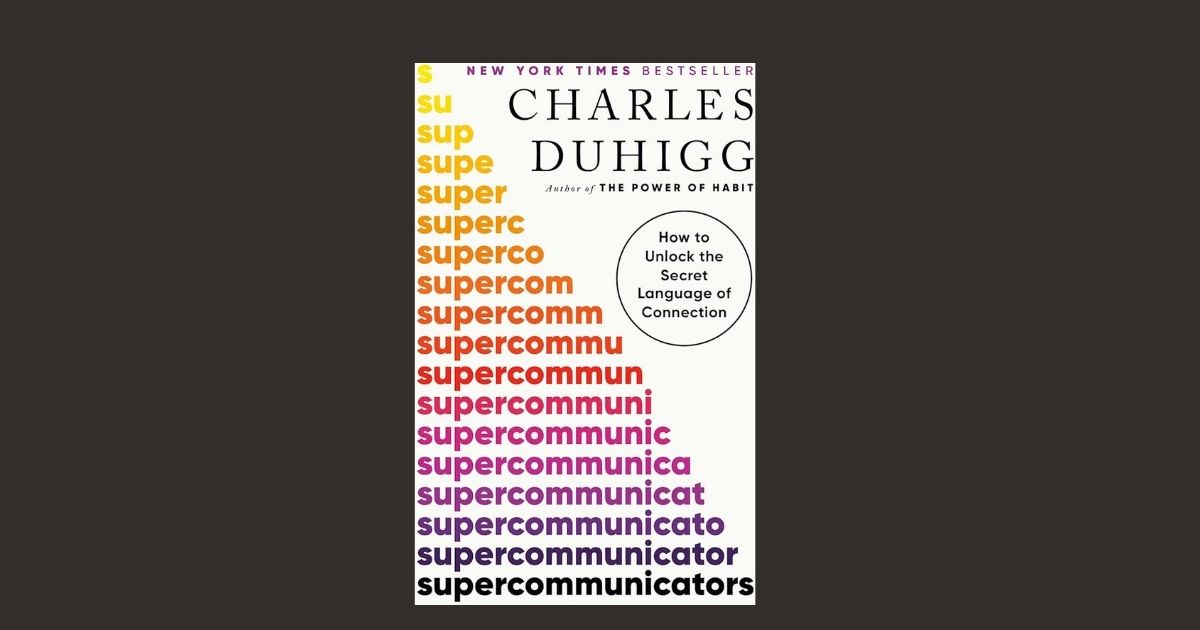
Supercommunicators: How to Unlock the Secret Language of Connection is the New York Times bestselling follow-up to Duhigg’s landmark The Power of Habit — and it may be even more immediately useful for leaders. It’s a rigorous, story-driven investigation into what the best communicators in the world actually do, and how the rest of us can learn to do it too.
Who Is Charles Duhigg?
Duhigg is a Pulitzer Prize-winning investigative journalist and staff writer at The New Yorker, best known for The Power of Habit — one of the most influential business books of the past two decades — and Smarter Faster Better. He has a gift, rare in science writers, for making research feel like a story you can’t put down, and for landing insights that stick long after you’ve closed the cover.
Supercommunicators is the book that grew out of a deceptively simple question: why do some people seem to connect effortlessly with almost anyone, while equally intelligent and well-intentioned people consistently miss the mark? The answer, as Duhigg discovered, has less to do with personality than with a specific set of perceptual habits that can be identified, studied, and — crucially — practiced.
So, What’s It Actually About?
Duhigg’s central insight is that every conversation is actually happening on three levels simultaneously — and most communication failures occur when the people in a conversation are operating on different ones without realizing it.
The three conversation types are: practical (What’s this really about? What decisions do we need to make?), emotional (How do we feel? Do we feel heard?), and social (Who are we to each other? How do we see ourselves in this situation?). Supercommunicators, Duhigg finds, have trained themselves to recognize which type of conversation is actually happening — which isn’t always the one that appears to be happening on the surface — and to match it.
That last part is key. Matching the conversation type isn’t about agreement or validation. It’s about meeting people where they actually are before trying to take them somewhere else. And Duhigg illustrates how this plays out across a remarkable range of contexts: a juror who leads a divided room to consensus, a CIA officer recruiting a reluctant agent, a surgeon who consistently fails to persuade patients to choose the safer treatment option, and the writers behind The Big Bang Theory who used these same principles to make a hit television show.
The book also explores the neuroscience behind what happens when communication works — what researchers call “neural entrainment,” the literal synchronization of brain activity that occurs in moments of genuine connection — and uses it to show why certain conversational behaviors create that synchrony while others reliably prevent it.
For leaders navigating cross-functional teams, resistant colleagues, difficult feedback conversations, or high-stakes negotiations, the applications are immediate and wide-ranging.
What You’ll Take Away
- Most miscommunication is a mismatch, not a misunderstanding. Duhigg’s most clarifying contribution is this: the reason so many conversations go sideways isn’t that people disagree — it’s that they’re having different types of conversations without knowing it. One person wants to solve a problem; the other needs to feel heard first. Diagnosing that gap is the first step to closing it.
- Ask more questions — the right kind. Duhigg’s research confirms and extends what Alison Wood Brooks found in TALK (our earlier Bookshelf pick): supercommunicators ask significantly more questions than average communicators, and particularly “deep questions” — ones that invite people to share their values, feelings, and experiences rather than just information. The effect on connection and trust is dramatic.
- Emotional conversations need to be recognized before they can be navigated. One of the book’s most practically useful chapters is about learning to notice when a conversation has shifted into emotional territory — even when no one has said anything explicitly emotional — and what to do when it has. For leaders who default to problem-solving mode, this section is both a challenge and a revelation.
- Vulnerability is a leadership tool. Duhigg cites research showing that when leaders share something genuine and human — a concern, an uncertainty, a real reaction — it doesn’t undermine their authority. It accelerates trust. This flies in the face of the armor-up instinct many high-achieving women have had to develop, and the data behind it is worth knowing.
- Connection can be learned. This is the book’s most empowering argument, and the one that makes it genuinely useful rather than just interesting. The skills of supercommunicators aren’t innate — they’re practiced. Duhigg gives you the framework to start practicing them, right now, in your next conversation.
Why We’re Recommending It
Leadership is ultimately relational. You can have the strategy, the data, and the title — and still lose the room if you can’t connect. Supercommunicators is the most rigorously researched, compulsively readable guide to that relational dimension of leadership we’ve come across in years.
If you’ve already read TALK by Alison Wood Brooks — another Bookshelf favorite — think of these two books as complementary rather than overlapping. Brooks gives you the science of conversation structure; Duhigg gives you the science of connection. Together they form an unusually complete picture of what it means to communicate at the highest level.
Read either. Read both. Your next difficult conversation will go better for it.
Get the Book
Supercommunicators: How to Unlock the Secret Language of Connection is available now wherever books are sold, including Amazon, BookPeople, and Bookshop.org.
Learn more about Charles Duhigg and his work at charlesduhigg.com.