

















What If “Having It All” Was Never Actually Possible — By Design?
You’ve probably heard some version of this your whole career: with the right mindset, the right habits, and enough discipline, you can have it all. The career. The family. The balance. And when it doesn’t come together the way it was supposed to, the implicit message is that you must be doing something wrong.
Wharton economist Dr. Corinne Low is here to tell you, clearly and with data: that’s not what’s happening.
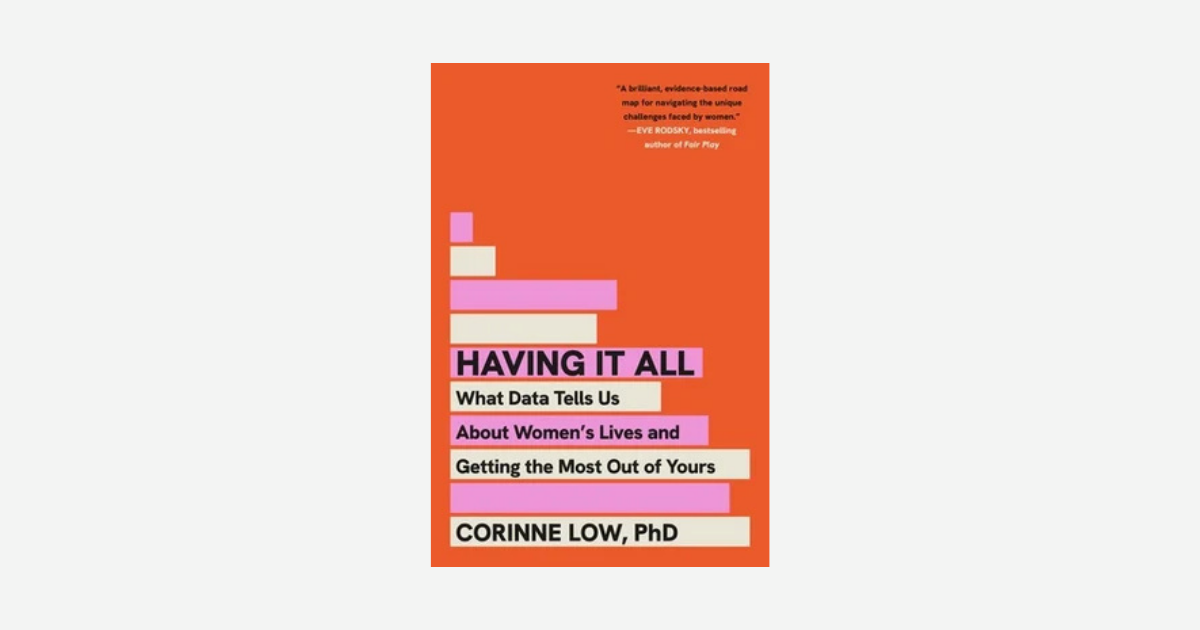
Having It All: What Data Tells Us About Women’s Lives and Getting the Most Out of Yours is the national bestseller that finally gives the exhaustion of professional women an economic diagnosis — and refuses to let personal choices take the blame for structural failures. It’s the book that puts words, and evidence, to what so many of us have long suspected.
Who Is Dr. Corinne Low?
Low is an associate professor of business economics and public policy at the Wharton School at the University of Pennsylvania, where she teaches an award-winning course on the economics of discrimination. Her research — published in journals including the American Economic Review and the Quarterly Journal of Economics — sits at the intersection of gender, labor markets, and the hidden economic forces that shape women’s lives. She has been featured in Vanity Fair, Harvard Business Review, and outlets across the political spectrum, and she previously worked at McKinsey & Company.
She is also a working mother who opened her book by describing a moment most working mothers will recognize: pumping milk in an Amtrak bathroom, crying, because she would miss putting her baby to bed. She wrote this book from inside the experience she was studying. That matters.
So, What’s It Actually About?
Low’s central argument is both simple and quietly radical: women aren’t failing to have it all because of poor choices, insufficient ambition, or inadequate optimization. They’re failing because the system was never designed for them to succeed — biologically, economically, or structurally — and the advice to “try harder” is the wrong prescription for a problem that isn’t theirs to fix.
She introduces the concept of “the squeeze” — the structural strain of being expected to compete fully in the labor market while also absorbing the majority of unpaid labor at home. Every hour spent on caregiving, household management, and emotional labor is an hour not spent on career advancement, and the math, as she shows, simply does not work out equally for women and men.
But Having It All is not a book about grievance. It’s a playbook. Low gives readers a framework for approaching the major decisions in women’s lives — career, partnership, family timing, negotiation — with the rigor of an economic analysis. She offers practical scripts, concrete strategies, and a clear-eyed framework for negotiating better deals at work and at home, starting with understanding what you’re actually up against.
What You’ll Take Away
- The system is the problem — and naming that changes everything. Low’s most important gift to readers is permission to stop blaming themselves. Understanding the structural and economic forces at work doesn’t make you a victim — it makes you a more effective strategist. You can’t negotiate a better deal if you don’t know the terms you’re working with.
- Treat your partnership like the economic arrangement it actually is. One of the book’s most counterintuitive and practically useful frameworks is approaching partnership decisions with the same rigor you’d bring to a business negotiation. Low is specific about what to look for, what to discuss, and what the data says about which arrangements actually produce happier outcomes.
- The timing of major life decisions matters more than we’re told. Low unpacks the hidden economic consequences of when women make decisions about education, career advancement, and family — and why the conventional wisdom about “optimal timing” often ignores the real tradeoffs women are actually navigating.
- Negotiation is non-negotiable. A significant section of the book is dedicated to the wage gap, the negotiation gap, and the specific scripts and strategies that help women close both. Low brings an economist’s precision to advice that is usually offered at the level of encouragement.
- The goal isn’t to do it all. It’s to design a life you actually want. The book’s ultimate reframe is this: “having it all” was always a myth. The real question is what you actually want — and how to build the conditions, at work and at home, that make that possible.
Why We’re Recommending It
Eve Rodsky called it groundbreaking. Adam Grant called it passionate, provocative, and evidence-based. Vivian Tu — whose book Well Endowed we featured last month — called it a must-read for women at every stage of life. We agree with all of them.
Having It All is the book that validates your exhaustion, explains it, and then hands you something useful to do about it. That combination is rarer than it should be.
Get the Book
Having It All: What Data Tells Us About Women’s Lives and Getting the Most Out of Yours is available now wherever books are sold, including Amazon, Barnes & Noble, Bookshop.org, and Books-A-Million.
Learn more about Dr. Corinne Low and her work at corinnelow.com.