


















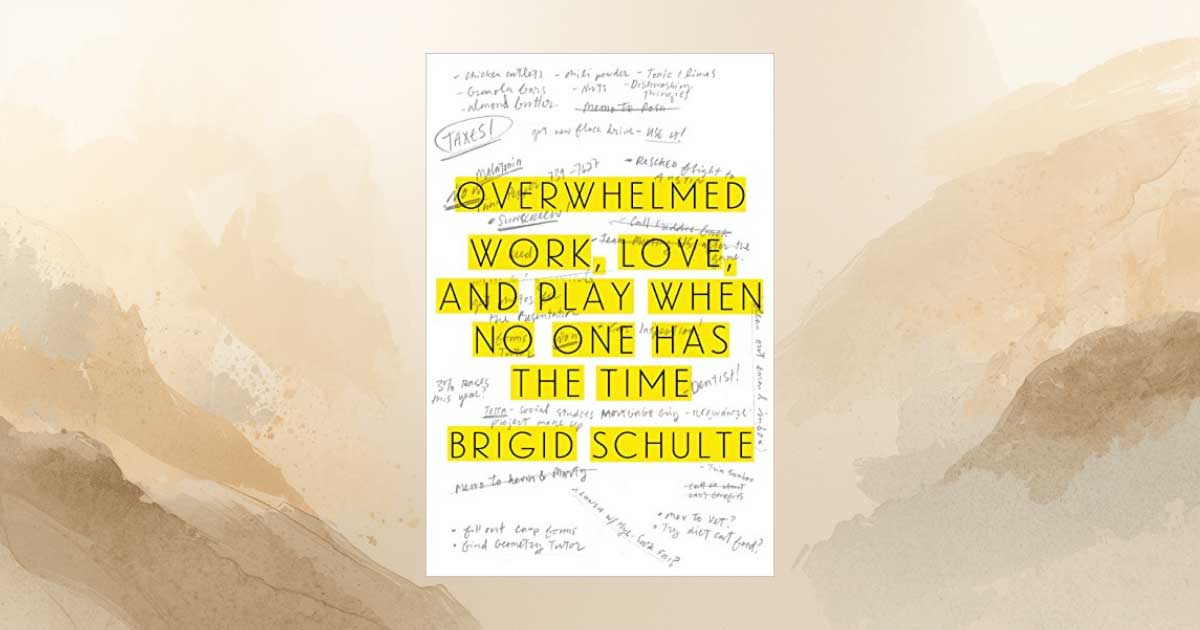
Some Books Are Ahead of Their Time. This One Is About Time.
Overwhelmed: Work, Love, and Play When No One Has the Time was published in 2014. And if you’re thinking “hasn’t that problem been solved by now?” — well, here you are, reading a blog post on your phone at whatever hour you managed to carve out for yourself today. So, no. It has not been solved.
What Brigid Schulte gave us over a decade ago was the first truly rigorous, deeply reported, often funny investigation into why so many working women feel like they’re perpetually behind — and what, if anything, can actually be done about it. It became a New York Times bestseller, was named a notable book of the year by the Washington Post and NPR, and won the Virginia Library Award for Literary Nonfiction. More importantly, it named something that millions of women had been feeling but couldn’t quite articulate.
We’re recommending it because that feeling hasn’t gone anywhere. If anything, it’s gotten louder.
Who Is Brigid Schulte?
Schulte is an award-winning journalist and Pulitzer Prize-winning reporter who spent nearly 17 years as a staff writer at the Washington Post. She’s also a fellow at the New America Foundation, a sought-after speaker, and — relevant to her credibility here — a working mother who wrote this book from inside the very experience she was investigating.
She didn’t set out to write a manifesto. She set out to answer one genuinely baffling question: a University of Maryland researcher told her that American women have, on average, 30 hours of leisure per week. She knew, in her bones and her calendar, that this could not possibly be true. What followed was several years of reporting across neuroscience, sociology, gender studies, workplace policy, and comparative international research — and a book that manages to be both a personal reckoning and a sweeping cultural diagnosis.
So, What’s It Actually About?
Schulte organizes the book around the three pillars that psychologist Erik Erikson identified as the components of a truly satisfying life: work, love, and play. Her central argument is that modern American culture — its workplace norms, its gender expectations, its always-on technology, its near-total absence of policy support for caregivers — has made it functionally impossible for most women to experience all three at once, or sometimes any of them fully.
The culprit she keeps returning to is what she calls “time confetti”: the way our hours get shredded into so many small, interrupted, obligation-laden fragments that even our technically “free” time doesn’t feel free. We’re answering emails during dinner, mentally drafting tomorrow’s to-do list during a run, and half-present during the moments that are supposed to restore us. Researchers call this “contaminated time” — and Schulte’s reporting on how it reshapes our brains, our relationships, and our sense of self is genuinely eye-opening.
She doesn’t stop at diagnosis, though. She travels to Denmark and the Netherlands, where work culture and family policy look radically different, and where people report far lower levels of stress without sacrificing professional ambition. She visits progressive companies experimenting with new models of work. She talks to couples who have actually figured out equitable divisions of household labor — and what that took. The picture she builds is both sobering and, ultimately, hopeful: the overwhelm is real, it is structural, and it is not your personal failing.
What You’ll Take Away
- “Time confetti” is the concept you didn’t know you needed. Once Schulte names the phenomenon of time shredded into too-small pieces to be genuinely restorative, you will see it everywhere in your own day. And seeing it clearly is the first step to doing something about it.
- You cannot schedule your way out of overwhelm. This is one of the book’s most liberating — and initially frustrating — conclusions. The problem isn’t your productivity system or your morning routine. It’s structural. Understanding that shifts the question from “what am I doing wrong?” to “what actually needs to change?” — which is a much more useful place to start.
- The “ideal worker” norm was designed around someone who doesn’t have a life outside work. Schulte traces the history of workplace culture with a reporter’s precision and a working mother’s fury. For anyone who has ever felt like the expectations of professional life were designed for someone else, this chapter is both validating and galvanizing.
- Leisure isn’t a reward. It’s a requirement. One of the book’s most counterintuitive arguments is about play — specifically, that true leisure (not scrolling, not half-watching TV while folding laundry, but genuinely restorative, present-tense enjoyment) is not an indulgence. It is what the ancient Greeks called the precondition for a good life, and what modern neuroscience confirms is essential for creativity, health, and sustainable performance.
- The bright spots are real — and replicable. Schulte doesn’t leave you in the diagnosis. She finds organizations, couples, and entire countries that have rebuilt the conditions for a less overwhelmed life — and she makes a compelling case that what works elsewhere can work here too, with the right intention and the right pressure applied in the right places.
Why We’re Recommending It Now
A decade after its publication, Overwhelmed reads less like a timely book and more like a foundational one — the kind that explains something so essential about working women’s lives that it belongs on the shelf alongside whatever you’re reading about leadership or career right now.
If you’ve ever ended a day feeling exhausted and somehow still behind, this book will make you feel less alone, more clear-eyed, and — maybe most importantly — significantly less likely to blame yourself for a problem that was never entirely yours to solve.
Get The Book
Overwhelmed: Work, Love, and Play When No One Has the Time is available now wherever books are sold, including Amazon, Barnes & Noble, Bookshop.org, and Books-A-Million.
Learn more about Brigid Schulte and her work at brigidschulte.com.