

















What If Employee Engagement Actually Meant Something?
You’ve heard it in every all-hands meeting, seen it in every annual report. Our people are our greatest asset. And if you’ve been around long enough, you’ve also watched organizations say exactly that — and then proceed to ignore their employees’ ideas, underinvest in their growth, and treat retention as someone else’s problem.
Dr. Angela Jackson has spent six years studying what happens when companies mean it instead.
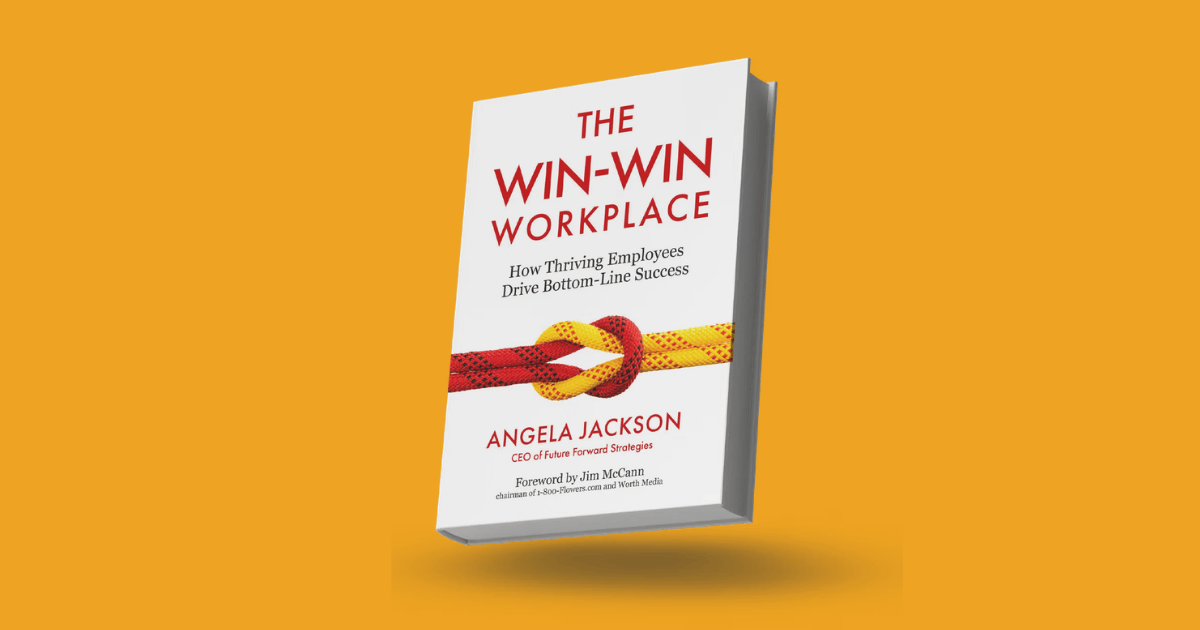
This month’s leadership pick is her instant New York Times, USA Today, and Los Angeles Times bestseller: The Win-Win Workplace: How Thriving Employees Drive Bottom-Line Success. It’s a data-backed, real-world argument that the best business strategy available to leaders right now isn’t a new technology or a cost-cutting initiative. It’s the people already in the building.
Who Is Dr. Angela Jackson?
Jackson is the founder and CEO of Future Forward Strategies, a labor market intelligence firm, and a lecturer at Harvard University, where she teaches the next generation of leaders about organizational change. She’s a widely published researcher — her work appears regularly in Harvard Business Review and the Stanford Social Innovation Review — and a sought-after keynote speaker who has taken the stage at TED and SXSW.
Before founding her firm, she served as Managing Partner at New Profit, where she led the Future of Work Grand Challenge, successfully reskilling 25,000 workers during the pandemic. She came up through senior global leadership roles at Viacom and Nokia. In other words: she has sat on both sides of this conversation, and she brings the data to back up everything she says.
So, What’s It Actually About?
The Win-Win Workplace is built on six years of research across more than 1,200 companies — including Walmart, Google, and JPMorgan Chase — and its central argument is both simple and quietly radical: when employees thrive, businesses do too. Not as a happy coincidence. As a measurable, reproducible, financially quantifiable outcome.
Jackson is the first researcher to calculate the actual dollar impact of investing in people, and the numbers are hard to argue with. Engaged, empowered employees drive higher productivity, stronger retention, better innovation, and improved profitability. The problem isn’t the data — it’s that most organizations still treat employee wellbeing as a cost center rather than a growth strategy.
The book walks through nine concrete strategies for changing that, grounded in real case studies from companies that have actually done it. She covers everything from centering employee voice and building high-trust relationships, to skills-based hiring, distributed leadership, and intersectional inclusion — the kind of inclusion that goes beyond checkbox diversity and actually reshapes how power and opportunity flow through an organization.
What makes this particularly relevant for the CFW community: Jackson is direct about the fact that the employees most consistently underutilized — and most consistently underestimated — are women, and especially women of color. The win-win workplace she’s describing isn’t just more profitable. It’s more equitable. And she makes the case that you can’t fully have one without the other.
What You’ll Take Away
- “People first” is a strategy, not a slogan. Jackson’s research puts hard numbers behind what many of us have sensed intuitively: organizations that genuinely invest in their employees outperform those that don’t. This book gives you the data to make that case — whether you’re the one in the C-suite or the one trying to influence it.
- Employee voice isn’t a nice-to-have. It’s a competitive advantage. One of Jackson’s nine strategies centers specifically on creating the structures that let employees actually shape decisions — not just weigh in on them. There’s a meaningful difference, and the companies that understand it are pulling ahead.
- Inclusion has to be intersectional to work. Jackson doesn’t let organizations off the hook with surface-level diversity metrics. She shows what it looks like to build workplaces where people with multiple marginalized identities aren’t just represented, but genuinely empowered — and why that specificity is what makes the difference.
- Skills matter more than credentials. One of the book’s most practical strategies involves hiring STARs — people who are Skilled Through Alternative Routes rather than traditional degrees. For leaders thinking about building deep, resilient talent pipelines, this reframe is both timely and actionable.
- You don’t have to be the CEO to use this. Jackson’s nine strategies aren’t just for the corner office. Managers at every level will find tools here for building higher-trust, higher-performing teams — and for making the case upward when the culture around them needs to change.
Why We’re Recommending It
A lot of leadership books tell you how to manage up, stand out, and advance your own career. This one asks a bigger question: what kind of leader do you want to be, and what kind of workplace do you want to build?
If you’re in a position to shape culture — or aspire to be — The Win-Win Workplace is one of the most rigorously researched, practically useful books we’ve come across in years. Jackson doesn’t just describe the problem. She hands you the blueprint.
Get the Book
The Win-Win Workplace is available now wherever books are sold, including Amazon, Barnes & Noble, Bookshop.org, and Books-A-Million.
Learn more about Dr. Angela Jackson and her work at readwinwinworkplace.com.