


















The Skill You Use Every Day and Still Have Room to Master
Think about how much time you spend in conversation. The one-on-ones, the performance reviews, the client calls, the hallway check-ins, the negotiations you didn’t realize were negotiations. Conversation is arguably the most-used professional tool you have — and yet most of us have never been formally taught how to do it well.
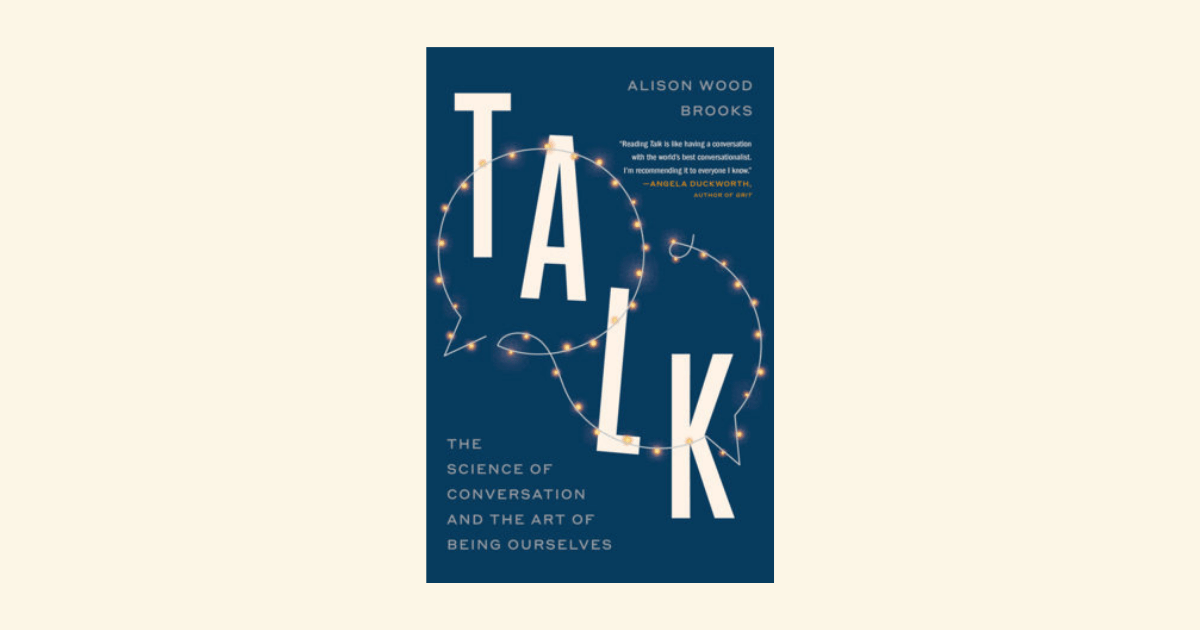
That’s the quietly startling premise of Alison Wood Brooks‘ instant #1 New York Times bestseller TALK: The Science of Conversation and the Art of Being Ourselves. And once she points it out, you can’t really unknow it.
Who Is Alison Wood Brooks?
Brooks is the O’Brien Associate Professor of Business Administration at Harvard Business School, where she researches the behavioral science of conversation, teaches an award-winning MBA course (also called TALK), and chairs an executive program called Communicating for Impact. She was named one of the Best 40 Under 40 Business School Professors by Poets & Quants — which is the kind of credential that sounds impressive until you actually read her work, at which point it just sounds accurate.
What sets her apart from the crowded field of communication coaches and “how to be a better listener” books is the rigor behind everything she says. Her insights come from years of actual research — analyzing speed dates, sales calls, parole hearings, and traffic stops to understand what makes conversation work, and what quietly derails it.
So, What’s It Actually About?
Brooks opens with a disarmingly honest observation: most of us are not as good at conversation as we think we are. We talk too much, listen too little, ask too few questions, and fumble the moments that matter most — not from bad intentions, but from lack of awareness. Conversation has a hidden architecture, she argues, and once you can see it, everything changes.
The heart of the book is her TALK framework — four maxims that structure every interaction:
- Topics: Choose and manage conversation topics with intention, including thinking ahead about what you actually want from a conversation before it starts (a habit Brooks’ own MBA students find uncomfortable at first and invaluable in practice)
- Asking: Ask more questions — genuinely curious ones, not performative ones — and understand why most people ask far fewer than they should
- Levity: Use humor to keep conversations alive and human, because warmth and wit aren’t unprofessional; they’re connective tissue
- Kindness: Prioritize your conversation partner’s needs alongside your own — a simple reframe that turns transactional exchanges into real ones
Brooks applies this framework across every kind of conversation: the high-stakes ones (negotiations, difficult feedback, job interviews) and the deceptively hard ones (small talk, reconnecting with someone, keeping a conversation going when it starts to stall). She also covers digital communication — texts, emails, social media — with the same rigor she brings to face-to-face interaction.
For mid-career women who are navigating complex relationships at every level — managing up, building laterally, leading their teams — this book is both a wake-up call and a working toolkit.
What You’ll Take Away
- Conversations have architecture — and you can learn to see it. Once Brooks gives you the framework, you’ll start noticing patterns you never could before: where conversations gain energy, where they lose it, and what you can do in real time to shift either.
- Asking questions is a superpower most of us underuse. Brooks’ research shows that people consistently ask fewer questions than they should — and that asking more, with genuine curiosity, is one of the single most effective ways to build trust, deepen relationships, and get better information. (Bonus: people who ask questions are rated as significantly more likable.)
- Thinking ahead about conversations isn’t awkward — it’s strategic. One of the book’s most counterintuitive suggestions is to prepare for conversations the way you’d prepare for a presentation — not scripting them, but getting clear on your goals, your opening, and the topics you want to explore. Leaders who do this are more confident, more focused, and more effective.
- Levity is a leadership skill. Brooks is direct about this: humor and warmth are not the opposite of professionalism. They’re the thing that makes professional relationships feel like actual relationships — which is what makes them durable.
- You can get better at this. This might be the most important takeaway. Unlike personality traits or innate charisma, conversation is a learnable skill. The research is unambiguous on this, and Brooks writes about it in a way that makes improvement feel genuinely within reach — not as a years-long project, but as a series of small, conscious shifts starting with your next conversation.
Why We’re Recommending It
Leadership is, at its core, a relational practice. You can have the strategy, the vision, and the technical expertise — but if you can’t connect, communicate, and read the room in real time, all of it gets harder than it needs to be.
TALK is one of those rare books that’s both rigorously researched and immediately applicable. You will finish it and walk into your next meeting differently. That’s not a small thing.
Get the Book
TALK: The Science of Conversation and the Art of Being Ourselves is available now wherever books are sold, including Amazon, Barnes & Noble, Bookshop.org, and Books-A-Million.
Learn more about Alison Wood Brooks and her research at alisonwoodbrooks.com.